
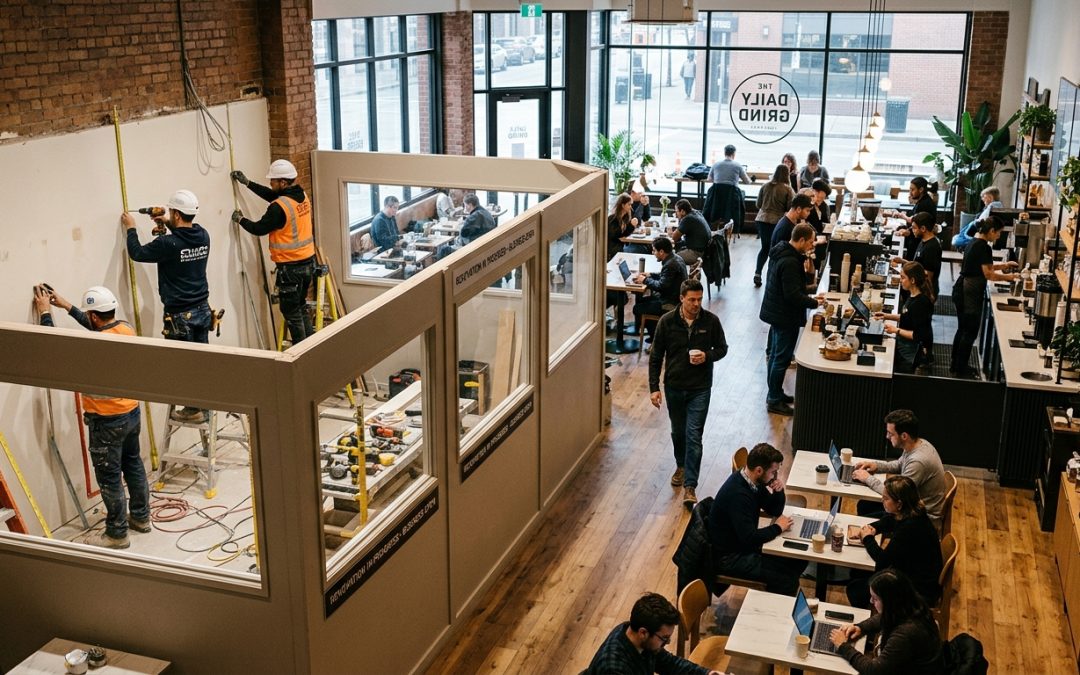
For many business owners, a commercial refurbishment presents an uncomfortable dilemma.
The premises need upgrading, but closing the business for weeks or months may not be commercially realistic.
That leads to an increasingly common question:
“Can we renovate our commercial property while continuing to operate?”
In many situations, the answer can be yes—but successful live-site construction requires considerably more planning than simply working around customers and employees.
Whether the project involves an office refurbishment, retail premises, hospitality venue or larger commercial upgrade, the construction programme must be designed around both the building work and the business itself.
Renovate Construction provides commercial renovation and construction services across Gold Coast, Brisbane, Sunshine Coast, Tamborine Mountain, Northern NSW and surrounding Eastern Coast areas, alongside its established residential renovation operations.
Start With Business-Critical Areas
Before developing the construction programme, identify which areas of the premises are essential to daily operation.
For an office, this may include:
- reception
- communications infrastructure
- staff workspaces
- meeting rooms
- bathrooms
For retail businesses, customer access, point-of-sale areas and product display zones may be critical.
Hospitality venues may depend heavily on kitchens, access routes, refrigeration and service areas.
Once these priorities are understood, construction can potentially be divided into logical stages.
What Is a Staged Commercial Renovation?
Rather than refurbishing the entire property simultaneously, the builder completes defined sections in sequence.
For example, one floor or department may be renovated while another remains operational.
When that section is completed, staff or operations can move into the finished space before work begins elsewhere.
This approach can reduce disruption but requires careful scheduling.
Each stage needs to consider temporary access, services, fire exits, deliveries, dust, noise and interaction between construction personnel and building occupants.
Can Work Be Done Outside Business Hours?
In some situations, yes.
Certain disruptive activities may be scheduled outside peak operating periods, subject to project constraints, approvals and local requirements.
However, out-of-hours construction should not be treated as the entire solution.
Some construction activities require extended curing times, inspections or sequential trades, making them unsuitable for a simple overnight work programme.
The best strategy is usually a combination of staging, scheduling and temporary operational arrangements.
Communication Becomes Critical
In occupied commercial premises, unexpected work can cause substantially more disruption than it might on an empty building site.
Management should understand:
- what work is happening
- which areas are unavailable
- expected noise periods
- planned service interruptions
- changes to access
- delivery schedules
- progress against programme
Contractors also need clear information about the client’s operational requirements.
Renovate Construction emphasises project management and ongoing client communication as key elements of larger construction projects.
Plan Service Interruptions Carefully
Commercial refurbishment frequently involves electrical, plumbing, air-conditioning or communications systems.
Any interruption to these services can affect business operations.
Rather than discovering this during construction, potential shutdowns should be identified during planning.
For example, if electrical systems must be disconnected, the work can potentially be scheduled at a lower-impact period.
The same principle applies to water, data, access systems and other essential infrastructure.
Separate Construction Areas From Occupied Areas
Safety is fundamental on every project, but live commercial sites create additional interfaces between construction activities and members of staff, customers or visitors.
Construction zones need to be appropriately controlled and managed.
Access routes, signage, material storage and deliveries should all be considered as part of the site plan.
Commercial builders should also coordinate trades so that unnecessary congestion and risk are reduced.
Consider Noise, Dust and Presentation
Construction affects more than physical access.
Noise can interfere with meetings, customer conversations and employee concentration.
Dust and debris can also create problems in businesses where presentation matters.
For retail, hospitality and professional premises, the customer’s perception of the environment may be particularly important.
Effective site management therefore includes practical measures for containing work areas and maintaining orderly surroundings.
Don’t Design Only for Today’s Business
A major commercial renovation should support where the organisation is going—not simply reproduce its existing layout with new finishes.
Consider future staffing, technology, accessibility, storage, workflow and customer requirements.
For an office, that might mean a balance between collaborative areas and focused workspaces.
For retail, circulation and product presentation may be central.
For hospitality, operational efficiency may significantly influence the layout.
The highest-value commercial projects combine construction expertise with a clear understanding of how the completed environment will actually be used.
Allow Enough Time for Pre-Construction Planning
One of the biggest mistakes is assuming the project begins when trades arrive on site.
For a significant commercial refurbishment, much of the important work occurs before construction begins.
This may include scope development, design coordination, approvals, procurement, staging strategy and programme development.
Renovate Construction’s own project-management guidance highlights approval delays, material shortages, poor coordination and unrealistic planning as common contributors to construction delays.
Choose a Contractor Who Can Manage Complexity
A live commercial project requires more than good trade workmanship.
The builder must coordinate people, programme, materials, safety, access and changing site conditions while understanding the commercial importance of keeping the client’s organisation operating.
That is particularly important for larger office refurbishments, retail environments, hospitality venues and multi-stage property upgrades.
For businesses across Brisbane, the Gold Coast and wider South East Queensland, Renovate Carpentry & Construction can discuss commercial renovation strategies designed around both construction requirements and business continuity.